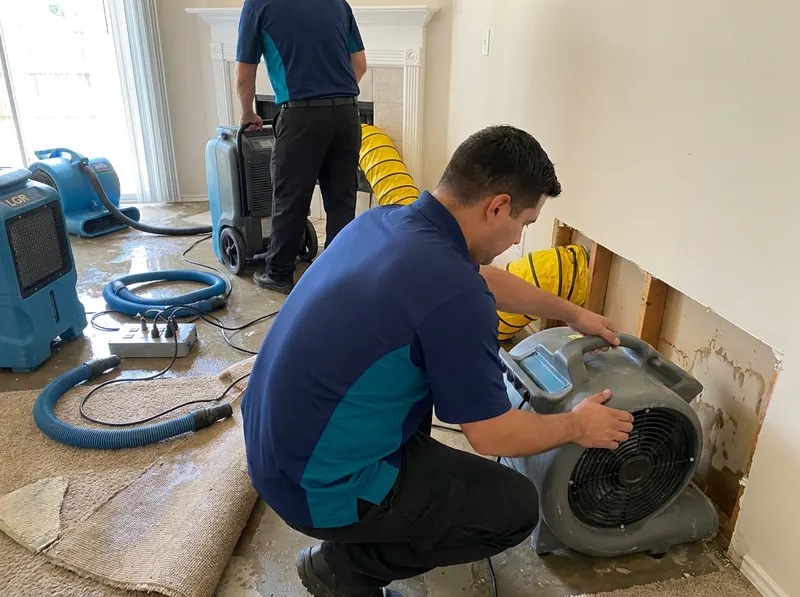
Drying is a measurement-driven process, not a fixed number of days. Technicians take moisture readings with a pin or pinless meter at set points each day and compare them to a dry reference reading taken from an unaffected area of the same material. Framing lumber in North Texas homes usually sits around 8 to 12 percent moisture content; the drying goal is to return wet framing to within a few points of that reference before equipment is pulled. The Institute of Inspection Cleaning and Restoration Certification (IICRC) S500 standard is the widely used reference for this drying and documentation process.
Equipment count is calculated from room dimensions and the class of water intrusion, not guessed. A common rule places one air mover per 10 to 16 linear feet of wet wall, plus one dehumidifier sized to the affected cubic footage. A single flooded bathroom in a Plano townhome might need 2 air movers and 1 dehumidifier; an open-plan first floor in a Southlake home after a supply-line break can need 8 to 12 air movers and 2 to 3 dehumidifiers. LGR dehumidifiers pull moisture even in the humid stretches DFW sees from May through September, when ambient outdoor humidity would otherwise slow evaporation.
Drying decisions differ by material and by the age of the structure. Older pier-and-beam homes in East Dallas and Oak Cliff have accessible crawlspaces and subfloor cavities that respond to targeted cavity drying, while the slab-on-grade construction common across Frisco, McKinney and Arlington traps moisture in concrete and bottom plates that takes longer to release. If drywall has been wet less than 48 hours from clean water, controlled drying often saves it; if the water was contaminated or the drywall stayed wet past roughly 72 hours, removal and rebuild usually replaces drying for that section. Hardwood floors are dried with specialty mat systems and monitored closely, since flooring that cups can sometimes flatten as it dries rather than needing full replacement.
A typical sequence runs: 1) confirm extraction is complete and standing water is gone; 2) take reference and affected moisture readings and log them; 3) calculate and place air movers and dehumidifiers; 4) return daily to re-read moisture and adjust equipment; 5) remove equipment once readings hit the dry standard and issue the completed drying log. That log is the document most DFW insurance adjusters ask for to confirm the structure was returned to dry standard.