Burst pipes spike in Dallas-Fort Worth during hard freezes, and the region has seen this at scale: the February 2021 winter storm caused thousands of pipe failures across Tarrant and Dallas counties when temperatures held below freezing for days. Older neighborhoods with pier-and-beam homes, such as parts of Oak Cliff, Fort Worth's Fairmount district, and East Dallas near Lakewood, are prone to freezing where supply lines run through unheated crawlspaces and exterior walls. Slab foundations across Plano, Frisco, and Arlington more often fail at hose bibs, attic runs, and second-floor bathrooms. The distinction matters because attic and upper-floor breaks send water through ceilings and down into two or more levels, which enlarges the drying footprint.
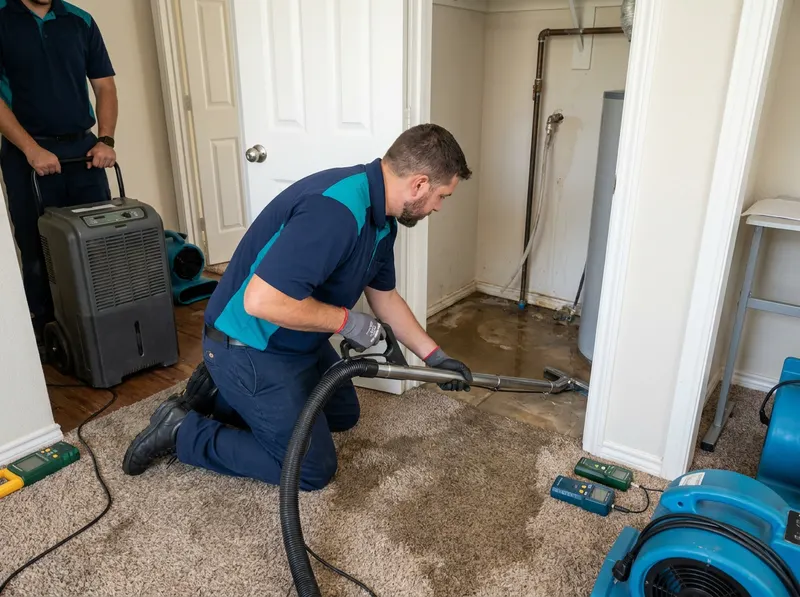
The response follows a set sequence. First, the water source is isolated at the main shut-off or the fixture valve. Second, standing water is extracted with truck-mounted or portable units. Third, wet materials are assessed: laminate and engineered flooring usually cannot be dried in place and are removed, while solid hardwood and structural framing are dried with directed airflow. Fourth, air movers and dehumidifiers run for several days while moisture readings are logged daily against dry-standard benchmarks. Fifth, the plumbing repair is coordinated so restoration and the pipe fix stay on one timeline.
Decision-fit comes down to water category and reach. A clean supply-line break caught within hours is Category 1 water and often dries with equipment alone, no demolition. A break that sat for a day or more, or one behind cabinets and inside wall cavities, usually needs targeted removal of drywall and insulation to prevent trapped moisture and mold. For a single fixture leak in one room, spot drying is the fit; for a freeze that split multiple lines across an attic and dropped water through two floors, full structural drying with material removal is the appropriate path. A burst-pipe cleanup is restoration work, not a plumbing service on its own, the plumber repairs the pipe, and the restoration crew handles the water, the drying, and the affected building materials.
Most burst and frozen pipe losses are covered under standard homeowner policies when the pipe failure is sudden and accidental, which applies to nearly all freeze breaks. Documentation with moisture logs and photos supports the claim. Insurers in Texas generally expect prompt mitigation, so drying that begins the same day helps limit both the damage and any coverage dispute over delay.