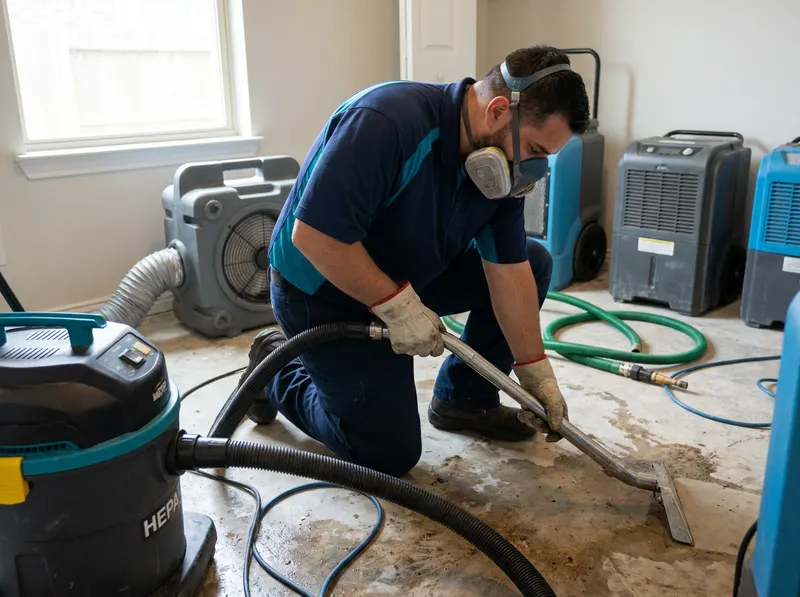
Category 3 water carries sewage, bacteria, and other harmful agents, which separates it from clean supply-line leaks (Category 1) and gray water from appliances (Category 2). The distinction drives the entire scope: under IICRC S500, Category 3 water contacting carpet, pad, and the lower section of drywall means those materials are cut out and discarded rather than dried in place. The standard reasoning is that porous materials cannot be reliably disinfected once saturated with contaminated water. This is the crucial non-obvious point, a sewage job is more demolition-and-disinfection than the dry-in-place approach used for a clean water leak.
A typical sequence runs in a set order. First, technicians in PPE contain the area and stop active flow. Second, contaminated water and solids are extracted. Third, non-salvageable porous materials are removed and bagged. Fourth, all remaining surfaces are cleaned and treated with an EPA-registered antimicrobial. Fifth, HEPA air scrubbers run while air movers and dehumidifiers dry the structure to a documented moisture target, often over 3-5 days. Clearance is verified with a moisture meter before reconstruction begins.
Sewage backups in Dallas-Fort Worth cluster in predictable spots. Older cast-iron and clay lateral lines under pre-1970 homes in East Dallas, Oak Cliff, and Fort Worth's Fairmount and Ryan Place trigger main-line backups, especially after heavy Trinity River watershed rain overloads the sanitary system. Slab-foundation homes across Plano, Garland, Mesquite, and Arlington see first-floor sewage surfacing at the lowest drain, a hall bathroom or laundry closet. Two-story homes in Frisco, McKinney, and Southlake with upstairs bathrooms can push contaminated water through the ceiling below, which widens the affected area and the cost.
Decision guidance depends on the source. If the water is a clean supply line or rainwater with no sewage contact, standard extraction and drying applies and most materials are saved. If the source is a toilet overflow past the bowl trap, a sewer main backup, or ground flood water, treat it as Category 3: assume porous material removal, disinfection, and regulated disposal. A single overflowing toilet caught within minutes may only need cleanup of a small footprint; a main-line backup that sat overnight typically means the whole affected room's carpet, pad, and lower drywall come out. Category 3 cleanup is not a mop-and-fan job, leaving contaminated porous material in place risks ongoing bacterial and mold growth.