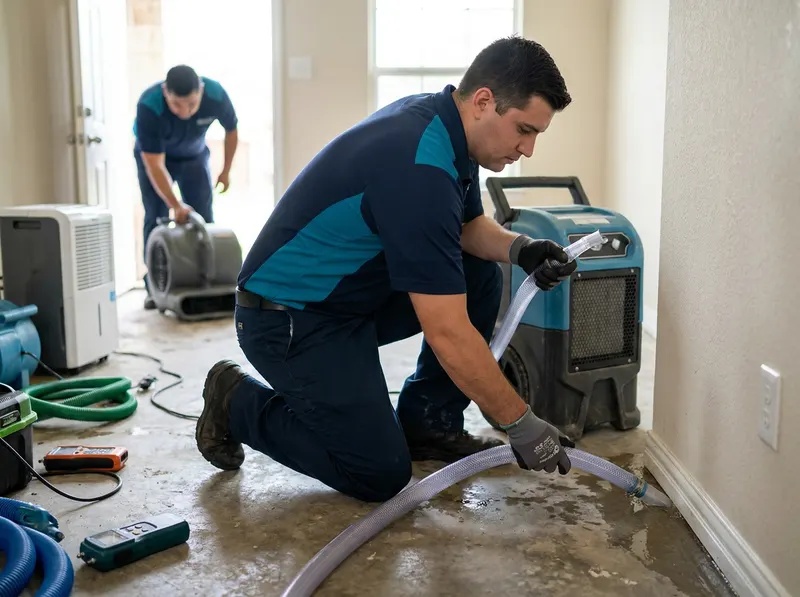
Storm and flood water recovery differs from a clean-water pipe leak because floodwater carries soil, bacteria, and runoff contaminants. Under the IICRC S500 standard, Category 3 water requires removal of drywall, carpet, pad, and insulation that contacted the water, rather than drying them in place. Dallas-Fort Worth sees this most during spring and early-summer storms, when the Trinity River and its tributaries, including White Rock Creek, Turtle Creek, and Bachman Branch, rise fast and back up into low-lying properties. Neighborhoods along the Trinity floodplain such as parts of West Dallas, Oak Cliff near the levees, and areas of Las Colinas in Irving carry higher flood exposure, and homes near Grapevine Lake and Joe Pool Lake see storm surge after heavy rainfall.
The recovery sequence runs in a fixed order. First, standing water is pumped and extracted with truck-mounted and portable units. Second, silt, mud, and any debris carried in by the water are shoveled and hauled out. Third, contaminated porous materials are cut and removed to a documented flood line, usually 12-24 inches above the highest waterline. Fourth, all remaining surfaces receive an EPA-registered antimicrobial. Fifth, air movers and LGR dehumidifiers dry the framing and slab to a target moisture content confirmed with a pin or pinless meter, bottom-plate wood should reach roughly 12-15% before rebuild begins.
Decision-fit matters here. If the water is clean and came from a supply line, a dry-in-place approach preserves drywall and saves demolition cost, that work falls under standard water extraction, not flood recovery. If the water rose from ground level, entered through a garage or door threshold, or came up through a floor drain, it is treated as Category 3 and porous materials are removed; skipping that removal risks mold growth within 24-48 hours in North Texas summer humidity. A single flooded bathroom is a small, fast job; a whole-slab flood across a 1,800-square-foot house is a multi-day recovery with several dumpsters of demolition debris, the trade-off is that faster extraction limits how much drywall and flooring must be torn out.
For insured storm and flood losses, crews document the waterline, moisture readings, and removed materials with dated photos so the file supports a claim. Flood damage from rising external water is generally covered only by separate flood policies, not standard homeowner policies, which is a common point of confusion after a Dallas-Fort Worth storm event.