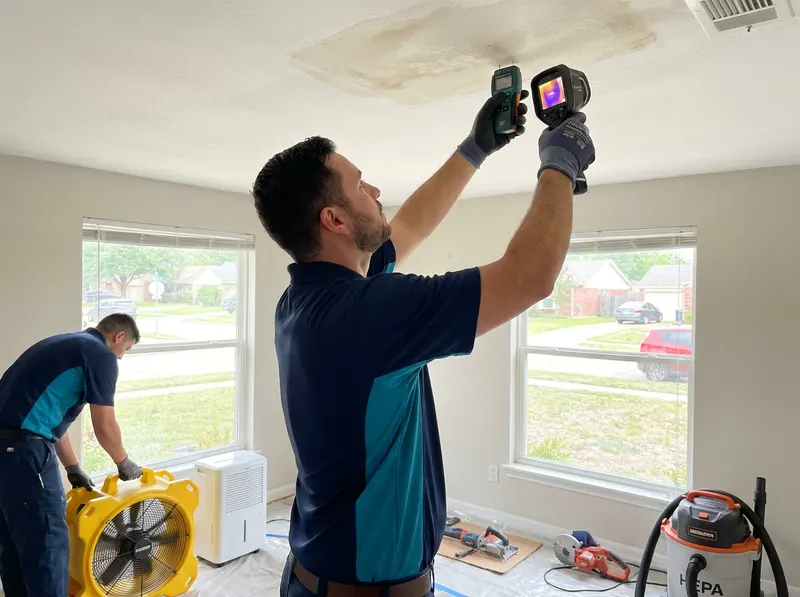
Overhead leaks show up as a brown ring, a sagging bulge, or a bubble of trapped water in the ceiling drywall. In Dallas-Fort Worth the four common overhead sources are second-story bathroom or laundry supply lines, attic HVAC units and their condensate drains, roof penetrations after wind and hail, and framing pipes that split during a hard freeze. Restoration starts by cutting or venting the trapped water so the ceiling does not collapse, then finding the true source, which often sits several feet away from the visible stain because water travels along joists and ductwork before it drips through.
Moisture readings and a thermal scan map how far the water has spread inside the cavity. Wet fiberglass or blown-in cellulose insulation loses most of its R-value once soaked and is removed rather than dried, since damp insulation holds moisture against the drywall and feeds mold. Two-story homes across Plano, Frisco, and McKinney frequently see upstairs bathroom leaks land on a downstairs living-room or kitchen ceiling; older single-story houses in Oak Cliff and East Dallas more often show attic-HVAC condensate stains near central return vents. Roof-origin leaks are common after North Texas hail events, when displaced shingles let water enter and pool on the attic side of the ceiling.
The repair path depends on how much material the water touched. A single stained ring under a dry cavity is often a spot repair: the affected section is cut out, the space is dried and treated, and new drywall is patched, taped, and textured to match. A wide sag, a sheet that has lost bond, or spreading mold points to full-panel removal, cavity drying with air movers and a dehumidifier, and new drywall hung across the ceiling. If the reader is deciding between a patch and a replacement: choose a spot repair when moisture readings show a small isolated area and the panel is still firm; choose full replacement when the drywall sags, crumbles, or shows mold, because a painted-over stain traps damp material and the ceiling fails again later. Textured ceilings built before the late 1970s across older DFW neighborhoods can contain asbestos in the texture, which requires testing before demolition.